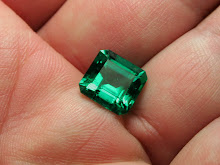
When you think of mining, you obviously think of the mines themselves. A coal mine or gold or silver mine are probably the first types to come to mind. Gem mines might come to mind next. Basically they’re all excavations in search of specific mineral or resource. And it goes without saying that successful mines find what they‘re looking for. Most of us probably assume a given mine just digs up whatever that is and there’s not much else to it. Without knowing much about minerals or mining, that’s probably a natural assumption. But it would be a wrong one.
So the question is then, what else do they find? Since this is mostly an emerald blog, we’ll take a closer look at what else might be found in a Colombian emerald mine. This won’t be a complete examination; instead we’ll just take a look at some of the more interesting things. I should also point out that the same gems or minerals found in a Colombian emerald mine may not be found in emerald mines elsewhere in places like Brazil, Zambia, or Pakistan, for example. One can think of the earth in these mining areas as a big mineral cocktail. And just like any cocktail you might order up at your favorite bar, the ingredients used have an effect on the end results. Throw another mineral into the mix in a gem mine and the results there may be different as well. The difference may be in the formation of other mineral types (including gemstones) and/or differences in the quality, characteristics, or formation of these minerals and gems. This helps explain why Colombian emeralds are much greener, more desirable, but also more included than their Brazilian, African, or Asian cousins. It also helps explain the existence in the emerald mines of some of the other minerals and gems I’m about to mention.
The first mineral I’ll talk about is what prompted me to write this blog. Have you ever heard of Colombian Euclase (pronounced YU-CLAZE)? Unless you’re a mineralogy buff or rockhound, I’m guessing probably not. Euclase is found in many places in the world, but it’s not often found to be of gem quality quite like it is in Colombia and Brazil. Colombian and Brazilian Euclase is highly regarded because of the beautiful blue color they possess. Euclase can also be found in yellowish, clear, and green variations in places like Austria, Brazil, the United States, Russia, Africa, among others. Quite often it is left in its crystal form still protruding from a piece of rock and bought by mineral collectors. Part of the reason for this is the difficulty in cutting the crystal to be used as a gem. Euclase has cleavage planes that intersect in its crystal structure and these planes can be a difficult obstacle for the inexperienced and unknowledgeable gem cutter. However, when done properly, cut Euclase is highly regarded and often sold at prices similar to those of good quality emeralds. Embassy Emeralds is one of the few places anywhere you will ever see cut Euclase available to purchase. The Euclase we carry all comes from the famous Chivor mine in Boyacá Department, Colombia.
Another mineral which is found without exception in a Colombian emerald mine is Pyrite. You might have seen this before and called it Fool’s Gold. It has a gold-like color and metallic appearance but has a crystalline structure that can be easily broken and crumbled in the hand. Pyrite is a very common inclusion found in Emeralds. If you have a particularly transparent emerald with a pyrite inclusion, you can often take a closer look at it with a loupe or magnifying glass. Pyrite isn’t worth much, if anything, but occasionally pyrite forms in the presence of a fossil and can replace the fossil material in its formation. What remains is a replica of the original fossil made of pyrite. This same fossil replacement process also may occur with emerald. Typically these fossils are the shells of mollusks lost in the earth and dating millions of years old. These mineral-replaced fossils are rare and valuable and often end up in private collections or museums.
Though not as common, apatite is another interesting mineral found in Colombian emerald mines. Specimens we’ve seen personally have been a light pink color, however the mineral apatite can be found in several colors such as: clear, black, blue, dark green, yellow, pink, red-brown, and purple. The variations in color are due to the make-up of the ‘mineral cocktail’ I mentioned earlier and other geological conditions under which it forms. The term apatite is actually a general term that is used to describe three subtypes of apatites named for the predominance of fluorine, chlorine, or hydroxyls. These subtypes are: Flourapatite, Chlorapatite, and Hydroxylapatite. Gem quality specimens can be cut as gems or cabochoned, however they rate as a 5 on the Moh’s Scale of Hardness making them a poor choice in terms of durability. Some apatites may exhibit the ‘Cat’s Eye’ effect known as chatoyance.
Quartz is the second most common mineral in the earth’s crust, so it’s a very likely find in an emerald mine. Like pyrite, quartz is a very common inclusion found in emeralds. Often these inclusions are tiny grain sized crystals that formed inside the emerald crystal. Quartz can be found in a variety of colors and types and some of these different types are even used as gemstones, such as Citrines, Amethyst, Jasper, and Onyx. However, most quartz found in emerald mines will be of the typically clear or white variety and you wouldn’t find them particularly useful for much of anything.
Another very common mineral found in emerald mines is calcite. Calcite is mostly white or clear and is a relatively soft mineral that is the main ingredient in the composition of sea shells, plankton, some sponges, and limestone among other things. You’ll often find calcite in veins near hot springs or in the form of stalactites and stalagmites in caves. It can be dissolved in ground water and tends to be carried with it to later form a sort of cement around other minerals and rocks, bonding them together. You might think of it as a mineral glue of sorts, holding rocks of varied composition together.
Belonging to the feldspar group, a mineral group that makes up the most common type of material in the earth’s continental crust, is Albite. Its name comes from the Latin Albus which describes its white color. Aside from being brittle and plentiful in an emerald mine, it’s a rather uninteresting mineral.
Those are some the more noteworthy or at least common minerals to talk about in an emerald mine, but there are many others. Dabbling with minerals and mineralogy can be an interesting endeavor but a daunting one if you’re someone who has to know everything there is about a subject. There’s just too much to learn. But as you can see, if your focus is limited as it is in this blog, it’s manageable and you won’t have to absorb a college geology department worth of reference books.
Friday, December 28, 2007
The Colombian Emerald Mine: More Than Just Emeralds

 Digg
Digg del.icio.us
  Reddit
  StumbleUpon
  Fark
Fark  Technorati
 Netscape
 Furl
FurlMonday, December 3, 2007
So, Are Those Feelings of Love Lab-Created Too?
It’s interesting that nearly all big-box jewelers these days are quick to point out how special their diamonds are, going on about their journey from mines in South Africa to the diamond markets in Antwerp, Belgium and beyond. They may even talk about the amazing properties that diamonds possess, such as their toughness and high thermal conductivity, and extreme rarity. And they’re also just as likely steer their customers away from synthetic diamonds.
So why is it that these same jewelers have no hesitation to sell synthetic emeralds? Sometimes called “cultured emeralds”, such gemstones are grown in a lab in a matter of days or weeks instead of the millions of years that it takes mother nature. These man-made stones exhibit similar colors and properties as natural emerald, and in some cases they even attempt to mimic the intricate imperfections found in natural emeralds. But like synthetic diamonds and other fakes, they just don’t stack up to the real thing.
Maybe it’s because emeralds from India, Africa and Brazil are inferior to their Colombian counterparts, universally considered to be the crème of the crop. And maybe they feel that sourcing Colombian emeralds is difficult or dangerous. Perhaps still they lack the skill and knowledge required to work with these stones. Whatever the reason, it’s disturbing that this double-standard exists.
I couldn’t imagine someone putting something as important as an engagement ring on the finger of a loved one knowing that the centerpiece was grown inside some imposing mechanical contraption or a lab dish; and I think it’s equally as criminal to do the same with an emerald.
Accept no imitations and demand the real thing. All of the emeralds at Embassy Emeralds are 100% genuine emeralds that have formed by natural processes over millions of years in the Boyacá region of Colombia.
Monday, October 22, 2007
My New Home: Colombia
Most people’s idea of Colombia consist of a combination of movie images and real life news. Let me go down the list of movies for you to check off in your mind. You’ve probably seen most of them.
- Collateral Damage
- Clear and Present Danger
- Romancing the Stone
- Proof of Life
- Maria Full Of Grace
- Blow
- Scarface
- The killing of Pablo Escobar in 1993. Perhaps the greatest criminal the world has ever known and quite possibly the most significant individual in the history of Colombia since Simon Bolivar led the fight for independence against Spain a few centuries ago;
- Armed struggled against the leftist guerrillas, the Fuerzas Armadas Revolucionarias de Colombia (FARC); the right wing paramilitary group, the Autodefensas Unidas de Colombia (AUC); and several other armed groups that often bump into each other in the jungle, evict civilians from their lands, provide security for drug shipping routes, and commit massacres and acts of terrorism;
- Drugs, drugs, drugs;
- Kidnappings for ransom;
- Murder, crime, terrorism;
- Shakira;
- Juan Valdez, the personification of the Colombian coffee industry;
- Beautiful emerald gemstones;
- The United States’ multi-billion dollar investment in Plan Colombia which helps fund the Colombian military and National Police among other things;
- Beautiful Colombian women/marriage agencies in Cali;
- President Bush’s recent 2006 visit to Bogota where an incredible 20,000 policemen were mobilized to provide security for a less than 24 hour visit;
- Mortar attack on President Alavaro Uribe’s inauguration ceremony;
- Rockets nearly hitting President Uribe’s helicopter with him and his wife on board;
For the most part, there is a very common theme to all of these movies and news stories. And that is one of danger. (I won’t exclude Shakira from this generalization because of the real possibility that standing too close to her could result in being knocked out by hipshake gone awry.) It is no secret that Colombia has been known as one of the most dangerous countries in the world for decades now. When you think of drugs trafficking, kidnapping, and guerrilla warfare, you think of Colombia. That’s the way it’s been for nearly 50 years and it’s a hard reputation to shake.
In Colombia’s defense, the situation has changed significantly in recent years. Murder and kidnappings are down something like 90 percent, Colombian citizens are travelling from city to city by car more, rebel leaders and drug lords are being captured or killed, paramilitary groups are disarming, and the overwhelming consensus is that security has improved greatly. Crime in general is down but certainly never far from anyone’s mind.
I may be crazy, but I guess I can say it’s been a dream of mine to come live here. And here I am. I’m sitting in a small, but comfortable apartment in downtown Bogota. It’s pretty safe here in my new home; the building is clean, well maintained, and has 24 hour security. It’s a bit of an oasis in an otherwise dingy and unsavory area. The street below is anything but a place I enjoy walking, day or night. I’ve been involved in milixtary operations in the Middle East, I’ve been a security manager on military installations as a civilian, and I’ve been to Colombia many times; so I have a good understanding and respect for what could be a dangerous situation. I won’t rule my new neighborhood out any time soon, but I am thrilled to be here.
Despite some problems, Colombia is one of my favorite places in the world. The people here are indomitable. Despite an ever-present war, domestic terrorism, prevalent crime, and terribly devastating poverty; the Colombian spirit is something is something I admire and respect greatly. They have a passion and appreciation for life and family unlike anything you’ll ever see. Rich or poor, seldom will you find a people with so much to give of themselves. This is one of the many reasons why I love Colombia and thoroughly enjoy being here.
Wednesday, October 17, 2007
Going the Extra Mile(s) for Christmas
Here I am in Colombia. A land feared and misunderstood my most, but a beautiful land and people with unforgettable experiences just waiting for those with the guts to put aside what people say to go see and feel for themselves what Colombia is all about. Ever since my first trip several years ago, it has been a sort of personal dream for me to come live here someday, but I never dreamed or expected it would happen like this. But that’s ok. Right now, this isn’t about me… I’m here for business. I’m here in the middle of Bogota with nothing but emeralds and emerald jewelry on my mind. I’ve left everything behind to spend the next few months personally filling emerald requests received from the website and cementing relationships with our sources that will last for years and years to come. When I’m not busy doing that, I’ll be working with local jewelers to bring new and unique designs to the world via Embassy Emeralds.
It is quite exciting to be putting it all out on the line for something you believe in. I believe in getting the best emeralds to our customers at a reasonable price and that’s what this is all about. We’re taking out the middle man, getting great deals on great stones, and passing it on to our customers. Not only are we doing that, but we’re giving the customer a level of service that is indeed uncommon. Where else can you request something as rare as a fine Colombian emerald to your specifications and then have an expert track it down for you straight from the source. In our minds, that’s great service and we’re sincerely excited about it. Not only do we get to spend our time sorting through hundreds of beautiful emeralds in search of that perfect stone, but we get to satisfy the customer in doing so. Everyone wins. If you’ve been dreaming of an emerald and you’re ready to make your dream a reality, now is the time. Contact us today.
Wednesday, August 15, 2007
Romancing the Stone

How great would it be though, to find a nice Colombian Emerald the size of ‘El Corazon’? Maybe I’ll ask around on my next trip to Colombia.
Embassy Emeralds - Your source for Premium Loose Emeralds from Colombia
Tuesday, August 7, 2007
Quick... Think of a Jewel
The majority of people, if asked to name a gemstone, would probably think of a diamond first. But this wasn’t always the case. In fact, diamonds themselves only became in favor once lapidaries learn to correctly cut and polish this otherwise dull material to unlock the fire and brilliance within. Long before all this however, colored gemstones- and particularly the emerald- were kings. While a well cut emerald round can be spectacular to behold, the uncut emerald crystal nestled amongst its matrix can be equally impressive.
In the middle and early ages, color was one of the most important characteristics in gemstones. Up until the discovery of the far superior specimens from Colombia in the 1600’s, most emeralds came from Egypt. But despite their poorer quality, the emerald still ran supreme.
With its grass green color, the emerald symbolized life, nature, and rebirth. The color green also has both spiritual and philosophical significance in a large number of cultures, both ancient and modern day. It has been said that to possess an emerald was to possess beauty herself.
Emeralds - Discover the Beauty of Most Ageless of Gemstones
Tuesday, March 27, 2007
Colombian Emeralds vs. Other Emeralds
Fact: It is undisputed in the gemstone and jewelry industry that the world's finest emeralds come from Colombia.
Often times the Muzo mine is mentioned by name. This is extraordinary compared to other precious gems. It is seldom the case for diamonds, sapphires, and rubies that one very specific source is so much more accepted for being superior gemstones, or is so much better known by name than the other mines or countries producing the same gem. Certainly, they have their famous names and their own acclaim, but it cannot be denied that Colombian emeralds stand out fare more when compared with their Brazilian and Zambian rivals.
On the average they are of higher quality, have better color, and are more sought after than other emeralds. Further, they are found in a more limited mining area which makes them even rarer and more highly valued.
Embassy Emeralds selects by hand each and every emerald you see on www.embassyemeralds.com from trusted suppliers in Muzo and other mines in Colombia.