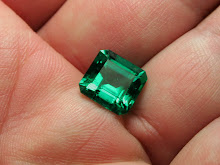
We recently had two articles published at the website www.ezinearticles.com, inlcuding:
Emerald Treatments
..and...
About Emeralds - Understanding the Four 'C's for Colored Gemstones
We invite you to give them a review; we belive they offer some interesting insight into emeralds.
Thursday, April 5, 2007
Articles about Emeralds

 Digg
Digg del.icio.us
  Reddit
  StumbleUpon
  Fark
Fark  Technorati
 Netscape
 Furl
FurlTuesday, April 3, 2007
The Lighter Side of Emeralds: An Insiders Look at Gemstone Marketplace (Part 1)
On a recent trip to purchase emeralds, I brought along a good friend to give him some insight into the world of emeralds and a small taste of Colombia. We visited a vendor that I had met years before, but whom I hadn’t seen in some time. While I stood back and chatted with the owner, my friend browsed over the selection of loose emeralds and finished jewelry, asking an occasional question of the lovely young Colombian lady working there. When he came to some lighter colored emeralds that really caught his attention he interrupted us to get us involved. He, like most people, was confused about the wide variations in color and clarity he was seeing in some the emeralds.
There was one emerald in particular that we discussed at some length. This emerald was unusual for a couple of reasons. First, it was not cut in one of the typical emerald cuts. It was cut more like a brilliant diamond. Second, the stone was very clear and transparent, with little color at all. Only a hint of green let you know this was an emerald by looking at it. As it turns out, the cut was a perfect match for this stone as the clarity really let the brilliant sparkle come through. I had seen this before many times, but I went ahead and bought the stone anyway simply because it was such a remarkable stone. It doesn’t follow "the rules" when it comes to emerald color, but its beauty is undeniable. The stone actually helps illustrate something I often tell my customers- buying gemstones and jewelry is a subjective thing; If it makes you happy and you apreciate how it looks, why buy something else? You can use the ‘industry preferences’ as a guide, but in the end, yours is the only opinion that matters.
(To be continued...)
Monday, April 2, 2007
An individual recently wrote us to inquire about the treatments used on the gemstones offered by Embassy Emeralds. It is true that not all dealers disclose the utilization of treatments, though we certainly believe they should. As you may know, treatments are used to enhance the visual appearance of the stone by filling minute fissures that exist in all natural emeralds, allowing for less interruption in the transmission of light as it passes thru the stone. Cedarwood oil is one of many available treatments.
How long the treatment will last depends on a number of factors, such as frequency of use (everyday vs. special occasions) and how the gemstones are stored when not in use. In particular, gemstones that are frequently exposed to high temperatures will loose the benefits of the treatment much faster than gemstones stored in a cool, dark, and dry place when not in use. In any case, once the treatment subsides, it can retreated a qualified jeweler.
Cedarwood oil has no effect on the durability of the stone.
Friday, March 30, 2007
The Emeralds Garden

Emeralds with inclusions that would be unacceptable in other gemstones are bought and sold every day at prices well above those of other 'non-included' gems. One has to look at each type of gem as its own distinct, individual species of stone and appreciate the differences, because each gem type is unique.
While on the subject of inclusions, it is also worth mentioning that stones from different sources often have certain inclusion traits that help determine the authenticity of the stone, as well as the origin. Trained eyes may even be able to tell which mine the emerald was taken from. In this way, inclusions can be helpful.
Thursday, March 29, 2007
Certifying Colored Gemstones
A common question among customers is why all colored gemstones arn't certified. Simply put, the biggest reason not to certify is cost. Costs to certify a stone can range from $150 - $300 from a recognized, reputable, and independent organization such as the American Gemological Laboratories or the AGTA Gemological Testing Center.
Besides these two institutions, there are many agencies and organizations that may issue gem certifications- and some may do it for less- but jewelers and insurers do not recognize many of these 'unknown' certificates. Even worse, certificates might be issued by the sellers themselves, creating conflicts of interest.
If you require a certification, the best advice is to buy stones certified by an independent organization that is industry recognized. If there's any doubt, look up the certifying agency or organization on the web and form your own opinions based on what you find.
Wednesday, March 28, 2007
Healing Properties of Emeralds
Maybe there is something in the flash as it catches our eye, but for countless centuries we have been fascinated by something deep inside gemstones. Mystics and Mages long ago bestowed fantastic properties on precious stones such as rubies, sapphires, and emeralds.
It was said that the emerald possessed special healing abilities, able to restore both mental and physical health. It's possible that much of this stems from its deep green color, something we often associate with nature and peacefulness.
In particular, emeralds were said to aid in improving or restoring eyesight, though this may come from a legend in which the Roman Emperor Nero was said to wear a monocle made from emerald, in which he used to observe the athletic games.
Tuesday, March 27, 2007
Colombian Emeralds vs. Other Emeralds
Fact: It is undisputed in the gemstone and jewelry industry that the world's finest emeralds come from Colombia.
Often times the Muzo mine is mentioned by name. This is extraordinary compared to other precious gems. It is seldom the case for diamonds, sapphires, and rubies that one very specific source is so much more accepted for being superior gemstones, or is so much better known by name than the other mines or countries producing the same gem. Certainly, they have their famous names and their own acclaim, but it cannot be denied that Colombian emeralds stand out fare more when compared with their Brazilian and Zambian rivals.
On the average they are of higher quality, have better color, and are more sought after than other emeralds. Further, they are found in a more limited mining area which makes them even rarer and more highly valued.
Embassy Emeralds selects by hand each and every emerald you see on www.embassyemeralds.com from trusted suppliers in Muzo and other mines in Colombia.
Subscribe to:
Posts (Atom)