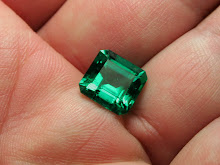
Colombia may not be the first place you think of when you plan a vacation, but you’d be surprised at how it’s catching on as a tourist destination. It’s not for the average tourist just yet, but those with an appetite for something different are experiencing the colonial romance of Cartagena, the tropical beach paradise of Tayrona, the beautiful women and salsa of Cali, eternal spring in Medellin, and perhaps the rapidly expanding center of it all in Bogota. Wherever it is that tourists are going, invariably they leave wanting to take some part of Colombia back with them. There are the usual items, coffee, woven bracelets, leathers, Botero figurines, and even brides; but those wanting to take back something truly special and valuable without getting married turn to Colombia’s world famous emeralds.
Travelers will find emeralds for sale in most of the major Colombian cities, but particularly in touristic Cartagena and in downtown Bogota, which is where most of the domestic and international-bound emerald trade is based. Cartagena is great for travelers who don’t plan to go inland, but you’ll pay tourist prices on just about everything… especially on emeralds. Cali and Medellin have their jewelry and tourist shops with emeralds for sale, but there isn’t much to choose from unless you go to fine jewelry stores. Don’t expect any bargains. For the best selection and your best chance at getting a good deal, there really is no alternative but to head to Bogota.
Before you even think about going to downtown Bogota looking for emeralds, or anywhere else for that matter, you really need to do a reality check and ask yourself the following questions... 1) How much do I know about emeralds? 2) How will I know I’m getting the real thing? and 3)How do I know I’m not getting the gringo discount? If an honest answer to the first question doesn’t scare you, you might be ok. But chances are the next website you visit will be Embassy Emeralds or the Google search page. Quite honestly, some of the best information you will find outside of a good jewelry and gemology book will be right here in our blog archives, on the About Emeralds page of the Embassy Emeralds website, or in the Emerald Encyclopedia. Do your homework!
If you completed the assignment, you might dare to slip on past question #1, but now you’ve come to the realization that in order to feel comfortable about question #2, you’re going to need some help. You could invest $100-$300 in a book or two, a loupe, a Chelsea filter, a synthetic emerald filter, and perhaps a few other tools you may never use again or you can contact us for help. We’ll arrange to talk by phone and be as helpful as we can. We don’t keep much inventory in Colombia, but we’ll gladly share some knowledge of a few local dealers we know to be reputable, advise you on the purchase, and even translate if needed. Expert help is always a good thing and it will help you eliminate doubts about question #3. If it doesn’t, you can always walk away to buy coffee and bracelets.
One last bit of advice… if you make it as far as where they sell emeralds and jewelry on your own, avoid the hundreds of emerald comisionistas you may see on the street. It’s no place to buy good, authentic emeralds or stand around with wads of pesos in your pockets. Good Luck!
Monday, April 14, 2008
Buying Emeralds on Your Travels to Colombia

 Digg
Digg del.icio.us
  Reddit
  StumbleUpon
  Fark
Fark  Technorati
 Netscape
 Furl
FurlFriday, December 7, 2007
A Word on our Products and Pricing...
Embassy Emeralds conducts all of its business up-front and in good faith with our very loyal and satisfied customer base. We have an excellent relationship and a great track record with our customers, and so we’d like to share with our you some information concerning our merchandise.
Our Emeralds
First and foremost, all of our emeralds loose or mounted are 100% genuine Colombian emeralds. Colombia is unquestionably where the best emeralds in the world are found. We purchase our stones from a very short list of reputable and knowledgeable suppliers in Colombia who receive their stones in rough form and have them cut by their teams of expert gem cutters. You’ll find it difficult to find many gemstone dealers who get their stock as close to the source as we do. We have great visibility into the entire process our suppliers go through from the acquisition of the rough emerald, to the cutting of the stones, and even the cedar oil treatment process. We can stand behind our stones as genuine because we’ve seen them in work from start to finish.
Our Emerald Jewelry
Our selection of emerald jewelry is unique and more special than one might know at first glance. Nearly all of our designs are originals, and some are one-of-a-kind jewels that may never ever be reproduced. But it is the quality of the stones and materials used that definitely sets us apart. Many online jewelers and major ‘brick and mortar’ jewelry chains use highly inferior African, Pakistani, or Brazilian emeralds that are often quite included and very surprisingly… quite a few of these so-called ‘high end’ jewelers even use synthetic or ‘cultured’ emerald (yikes!).
Gold and Platinum
Quality jewelry is what you expect and quality jewelry is what we deliver. Every item in our inventory is made from only what we say it is and we only use the highest quality metals. Any 18kt white or yellow gold ring is made only from 100% high quality, 18kt white or yellow gold…every feature… all the way through. You won’t find electroplated steel or cheap gold alloys in anything we sell. The same goes for any platinum items we sell. If you request a piece of jewelry custom made, we can have those items made exactly as you specify in whatever karat rating of gold you desire.
Diamonds
The quality of the emeralds in our jewelry is a major selling point for us, and we apply the same quality focus to the diamonds we use as well. If you don’t know much about diamonds, remember this… like emeralds, not all diamonds are created equal. When we first came into the jewelry scene we managed to find some very very cheap diamonds in the 0.01 to 0.05 carat range that could be used for accent stones. At just a few dollars each, they’d be quite a bargain for a jeweler who only cares about mentioning the word diamond in the product description. When we looked closely at these diamonds using just a 10X jewelers loupe, we were disgusted at what we saw. Not just because of the very bad color and heavily included nature of these diamonds, but also they were absolutely full of ‘garbage’ and tiny cracks and severe faults that steal away their brilliance. When you see cheap jewelry containing diamonds and other precious stones, unfortunately this is what you get. Always keep in mind… It’s all about quality.
Luckily for you, we do have standards, and we have excellent sources for high quality diamonds. We know the difference between a cheap diamond and a good one is very noticeable and significant, and so we pay several times more for even the smallest diamond accents to get quality diamonds that live up to our standards and your expectations.
Craftsmanship
Every jewelry item we sell is handmade by an expert jeweler with decades of experience and very often they are original pieces shaped and constructed one at a time. They are not mass-produced or made by machines. Popular designs may later become molds, but even still, these jewels are unique because the stones they employ will be always be different and unique.
Pricing
Regarding pricing, Our philosophy on pricing is: We’re happy if you’re happy. The goal is to sell emeralds and emerald jewelry, please the customer, and make a living. We’re not fooling ourselves into thinking that we’re going to get rich and retire on a single sale, and so we don’t try to.
Embassy Emeralds offers emeralds and jewelry that fit into two categories… items that we have in our inventory and items that we have exclusive authorization to sell from our supplier. We apply different pricing strategies to these two categories of merchandise in order to keep our prices reasonable and consistent with the quality of the merchandise being sold.
You may see some of our items and be surprised by the prices that go along with them. You’re surprised because you don’t usually see stones of this quality in the jewelry you’re browsing. If you’re surprised by that you might also be surprised to learn that many of these items are actually priced below their fair market value. Please consider what you’ve read above about the quality of the metals, emeralds, and diamonds used, and the craftsmanship that goes into creating these beautiful original masterpieces. All of our merchandise is priced fairly and based on its cost. This cost is directly related to the quality of the stones used, and the amount of gold or platinum required to make the item. In the end, you’re getting a far superior jewel than what you’ll find in any major jewelry chain. Admittedly and unfortunately, this does limit our market somewhat because the quality of our merchandise can push prices out of many people’s budget, but we believe it is important to keep our focus on the quality of the jewels we’re selling. However we do try to offer lower priced items for all budgets without compromising our standards. We also can make items on request that may help meet your budget concerns. If you’re interested in custom made jewelry, feel free to write to us and we’ll work with you from start to finish to make whatever you desire. We have access to other gems besides emeralds, such as sapphires, rubies, Colombian blue euclase, diamonds, and others, so please do contact us at: info@embassyemeralds.com.
We hope this information helps you understand our approach to our business. We know if you place your faith in us, you’ll be extremely pleased with your purchase and you’ll be back for more.
Monday, December 3, 2007
So, Are Those Feelings of Love Lab-Created Too?
It’s interesting that nearly all big-box jewelers these days are quick to point out how special their diamonds are, going on about their journey from mines in South Africa to the diamond markets in Antwerp, Belgium and beyond. They may even talk about the amazing properties that diamonds possess, such as their toughness and high thermal conductivity, and extreme rarity. And they’re also just as likely steer their customers away from synthetic diamonds.
So why is it that these same jewelers have no hesitation to sell synthetic emeralds? Sometimes called “cultured emeralds”, such gemstones are grown in a lab in a matter of days or weeks instead of the millions of years that it takes mother nature. These man-made stones exhibit similar colors and properties as natural emerald, and in some cases they even attempt to mimic the intricate imperfections found in natural emeralds. But like synthetic diamonds and other fakes, they just don’t stack up to the real thing.
Maybe it’s because emeralds from India, Africa and Brazil are inferior to their Colombian counterparts, universally considered to be the crème of the crop. And maybe they feel that sourcing Colombian emeralds is difficult or dangerous. Perhaps still they lack the skill and knowledge required to work with these stones. Whatever the reason, it’s disturbing that this double-standard exists.
I couldn’t imagine someone putting something as important as an engagement ring on the finger of a loved one knowing that the centerpiece was grown inside some imposing mechanical contraption or a lab dish; and I think it’s equally as criminal to do the same with an emerald.
Accept no imitations and demand the real thing. All of the emeralds at Embassy Emeralds are 100% genuine emeralds that have formed by natural processes over millions of years in the Boyacá region of Colombia.
Monday, October 22, 2007
Catching Fire
Photography is a hobby and an occupation enjoyed by millions of people. And for good reason. There’s something about capturing a moment in time, an image, an action, or even an idea as it occurs and showing it to the world in a way that can’t be duplicated with words alone. It doesn’t matter how many words you use, you cannot convey precisely the same message as a photograph. Photography is perception, background, history, context, and the message all in one visible word. Photography is also art, communication, and many times photography is proof. It can be proof of an existence, an action, a condition, among other things. Photography is versatile but yet often quite absolute.
In gemstone photography, photography is an image and one of proof, although it is a proof that is difficult to achieve. Gemstones and jewelry might possibly be some of the most difficult subjects to photograph. Rarely is a subject so dynamic and its true color so important as it is when trying to record an accurate image of a gemstone or piece of jewelry. It isn’t often we go through pictures in the family photo album or pictures of last summer’s vacation and scrutinize the color and clarity of the photographs. It just isn’t that important. It is when you’re talking about gems. A small tonal difference can create the perception of a stone that would be worth hundreds of dollars less per carat. The reason for the difficulty in capturing a gem’s true essence is usually a combination of lighting and the camera itself. Both of these problem areas can be improved upon with some investment in professional photography and lighting equipment, but rarely are they overcome completely.
I can imagine the online gem shopper who now might be asking themselves, ‘So… how do I know what I’m buying if the photo may not be telling me the whole story?’ It’s understandable to think that way, but luckily the camera seldom makes a bad stone look good. They’re just stuck looking bad. But for good, fine, and decent stones, without fail, stones appear much better in person than what is shown in the photo because a single still image can’t capture the dynamic fire and brilliance of a stone dancing in the light. So it stands to reason, and generally holds true that if you pick a stone you like from a good photograph, you’ll be even more pleased when you see it in person.
Thursday, October 18, 2007
How Much is my Emerald Worth?
One of the most common types of emails we receive at Embassy Emeralds is the: ‘How much is this emerald worth?’ email. It seems like a good question and certainly an innocent one. After all, many people think that emeralds, diamonds, and other gemstones are bought and sold as a commodity like gold, silver, oil, soybeans, etc… But this just isn’t the case, and so we must invariably reply with the ‘sorry, we’d have to see it in person’ email. Which is not too helpful but we try to explain the reasons why.
Each individual emerald sold to the consumer is valued individually based on the quality of that particular stone. For some gems, assessing quality is a simple matter, but for emeralds, it is perhaps one of the more difficult to assess. This is due to the almost endless possibilities of variance in the important emerald characteristics. One characteristic is the natural tendency for emeralds to contain inclusions...much more so than other gemstones. Inclusions that are acceptable in emeralds are not at all acceptable in most other gemstones such as diamond, sapphires, rubies, and topaz to name just a few. Variances in clarity is another key point to look evaluate, but perhaps most important is color. After all, we love colored stones because of their beautiful colors. A slightly better shade of color from one stone to the next can equate to a difference in price of hundreds or even thousands of dollars per carat.
We say it all the time, but nearly any quality assessment is based on the 4 C’s of Color, Cut, Clarity, and Carat. If you’d like to do an amateur assessment you should look at those areas, but you need to know something about the stone your assessing and you should know and have seen how these 4 C’s can vary from the lowest quality stones to the finest. This is something not many people have the luxury of knowing.
For an accurate assessment by a professional, it is absolutely essential for them to be done in person to see the combination of these important features of the stone and how they work together to create a complete image of quality. It should be stressed (not just noted) that the majority of jewelers are not good at gemstone assessments. Accurate assessments are done by qualified gem dealers or gemologists.
If you’ve ever written the ‘how much is my emerald worth’ email. Don’t feel bad. You didn’t know. But hopefully this blog helps you understand why you didn’t get the response you were looking for or educates others why writing the same email won’t be helpful to them.
Wednesday, September 5, 2007
How much are emeralds worth per carat?
We often get questions like this, and they are never easy to answer. The correct answer is that an emerald is worth what people will pay for them and that price depends on the quality and rarity of the stone. Several factors, but in particular, the 4 C’s of Color, Clarity, Cut, and Carat become the quality bases of any valuation to be made. You’ll find a discussion of the 4 C’s on our About Emeralds page. If you were to apply those 4 C’s as you browse a varied selection of emeralds, you’d quickly understand their importance in making a determination of an emerald’s quality. In a given selection you’d see cloudy, milky colored stones; emeralds that lack true emerald green color; ‘eye-clean’ stones; heavily included stones; badly cut or chipped stones; as well as small and large stones.
All of these variations are out there, so it would be impossible to assign a single market price to all emeralds. Instead they are evaluated on a more individual basis or sometimes in the ‘lots’ by which they may be purchased from the supplier. The lowest quality emeralds, which probably do not deserve that name, might be found for perhaps $10-$80 per carat if priced fairly in emerald markets. They may be green, but would probably lack the typical coloration and other gem qualities that a specimen of Green Beryl requires to be classified as an ‘Emerald’. Still, there are many who will market these poor quality stones as emeralds at ridiculous prices. Above that, you have stones that you might classify collectively as ‘commercial quality’. That term can be used to describe emeralds in a very broad quality range that would be found in most of the emerald jewelry available to consumers. Prices per carat for these stones vary greatly and can reach a few thousand dollars per carat, but size and the 4 C’s will have a lot to do with it. Beyond that, pricing of very fine emeralds is another world all together. Some may be affordable at perhaps as low as $1,000 but others may reach up to an amazing $50,000 per carat if you can believe it. Though a $50,000/ct emerald would be impossibly rare, very large, absolutely flawless, and would certainly have some important history or other significance to it. Even emeralds in the $5,000-$10,000 price range are rare, but certainly obtainable.
Loose Emeralds from Embassy Emeralds - Great Selection/Spectacular Prices
Wednesday, August 15, 2007
Romancing the Stone
 I saw Romancing the Stone on TV the other day and it was quite interesting to see how my perception and opinions have changed over time. I forced myself to watch it to get a look at the large Colombian Emerald that the movie revolves around. It was tough, but I did make it to the end. Wow, what a cheesy movie. I recall seeing it back in 1984 and I thought it was pretty cool. Maybe I was drawn in by the adventure parts where Michael Douglas and Kathleen Turner found themselves in the jungle or the interesting fortress setting of Cartagena, but seeing it again after all this time, I think I must have been on some of the drugs they found in that crashed airplane in the beginning.
How great would it be though, to find a nice Colombian Emerald the size of ‘El Corazon’? Maybe I’ll ask around on my next trip to Colombia.
Embassy Emeralds - Your source for Premium Loose Emeralds from Colombia
Diamonds in the Moonlight
Being in the gem and jewelry business, I am constantly thinking of ways to promote my business. The other day I was going through in my head some of the advertisements or commercials I’ve seen that were memorable or really seemed effective. There is one in particular that really sticks out. I believe it was more of a campaign with several different variations on the same commercial concept, but it was very simple and powerful. It contained nothing more than water, a beautiful woman, her diamonds or diamond jewelry, and the moonlight reflecting off the water and/or diamonds. The rest of the background was completely dark. Nothing else was at all visible. The diamonds in were extremely bright and captured your attention completely even successfully making the beautiful woman seem secondary.
If only I could capture that sort of attention in a similar fashion but my emeralds. I think it would be effective if done in the same way, but of course that’s not very original. Maybe the blog community might have some ideas or might share some examples of emeralds being presented effectively.
Embassy Emeralds - Loose Emeralds Direct from Colombia.
Tuesday, August 7, 2007
Quick... Think of a Jewel
The majority of people, if asked to name a gemstone, would probably think of a diamond first. But this wasn’t always the case. In fact, diamonds themselves only became in favor once lapidaries learn to correctly cut and polish this otherwise dull material to unlock the fire and brilliance within. Long before all this however, colored gemstones- and particularly the emerald- were kings. While a well cut emerald round can be spectacular to behold, the uncut emerald crystal nestled amongst its matrix can be equally impressive.
In the middle and early ages, color was one of the most important characteristics in gemstones. Up until the discovery of the far superior specimens from Colombia in the 1600’s, most emeralds came from Egypt. But despite their poorer quality, the emerald still ran supreme.
With its grass green color, the emerald symbolized life, nature, and rebirth. The color green also has both spiritual and philosophical significance in a large number of cultures, both ancient and modern day. It has been said that to possess an emerald was to possess beauty herself.
Emeralds - Discover the Beauty of Most Ageless of Gemstones
Wednesday, July 11, 2007
Buying Gems and Jewelery
Buying precious stones has become big business in the United States as people seem to have more disposable income and are trying to come up with interesting jewelry ideas to create unique, one-of-a-kind pieces. This might seem to some to be another vain instance of first-one-on-the-block syndrome, but buying precious stones and valuables such as jewelry is really an excellent and practical idea.
Much like buying certain commodities such as gold and silver or perhaps like buying savings bonds, buying gemstones and jewels is safe way individuals can ‘store’ wealth. And an added benefit of doing so is that you can make use of it at the same time. Very few investments or items we buy can make that claim. Gems and jewelry can be worn giving the individual all the benefits of status, prestige, and a sense of happiness and yet still keep or even increase in value. This really isn’t a new concept. Many governments, or we can even say… civilizations have done this since gold, diamonds, emeralds, and all these fine treasures of the earth were first discovered.
Loose Emeralds from Embassy Emeralds - An ideal source for emeralds from Colombia
Thursday, April 5, 2007
Articles about Emeralds
We recently had two articles published at the website www.ezinearticles.com, inlcuding:
Emerald Treatments
..and...
About Emeralds - Understanding the Four 'C's for Colored Gemstones
We invite you to give them a review; we belive they offer some interesting insight into emeralds.
Tuesday, April 3, 2007
The Lighter Side of Emeralds: An Insiders Look at Gemstone Marketplace (Part 1)
On a recent trip to purchase emeralds, I brought along a good friend to give him some insight into the world of emeralds and a small taste of Colombia. We visited a vendor that I had met years before, but whom I hadn’t seen in some time. While I stood back and chatted with the owner, my friend browsed over the selection of loose emeralds and finished jewelry, asking an occasional question of the lovely young Colombian lady working there. When he came to some lighter colored emeralds that really caught his attention he interrupted us to get us involved. He, like most people, was confused about the wide variations in color and clarity he was seeing in some the emeralds.
There was one emerald in particular that we discussed at some length. This emerald was unusual for a couple of reasons. First, it was not cut in one of the typical emerald cuts. It was cut more like a brilliant diamond. Second, the stone was very clear and transparent, with little color at all. Only a hint of green let you know this was an emerald by looking at it. As it turns out, the cut was a perfect match for this stone as the clarity really let the brilliant sparkle come through. I had seen this before many times, but I went ahead and bought the stone anyway simply because it was such a remarkable stone. It doesn’t follow "the rules" when it comes to emerald color, but its beauty is undeniable. The stone actually helps illustrate something I often tell my customers- buying gemstones and jewelry is a subjective thing; If it makes you happy and you apreciate how it looks, why buy something else? You can use the ‘industry preferences’ as a guide, but in the end, yours is the only opinion that matters.
(To be continued...)
Monday, April 2, 2007
An individual recently wrote us to inquire about the treatments used on the gemstones offered by Embassy Emeralds. It is true that not all dealers disclose the utilization of treatments, though we certainly believe they should. As you may know, treatments are used to enhance the visual appearance of the stone by filling minute fissures that exist in all natural emeralds, allowing for less interruption in the transmission of light as it passes thru the stone. Cedarwood oil is one of many available treatments.
How long the treatment will last depends on a number of factors, such as frequency of use (everyday vs. special occasions) and how the gemstones are stored when not in use. In particular, gemstones that are frequently exposed to high temperatures will loose the benefits of the treatment much faster than gemstones stored in a cool, dark, and dry place when not in use. In any case, once the treatment subsides, it can retreated a qualified jeweler.
Cedarwood oil has no effect on the durability of the stone.
Friday, March 30, 2007
The Emeralds Garden
 One of the most unique characteristics of an emerald is its inclusions. All emeralds are included, so people accept it, and at times, even value this trait. Inclusions or features within the stone are often referred to as its 'garden'. They are not considered 'a bad thing' unless they negatively impact the stone's integrity or significantly affect its ability to capture, reflect, and manipulate light.
Emeralds with inclusions that would be unacceptable in other gemstones are bought and sold every day at prices well above those of other 'non-included' gems. One has to look at each type of gem as its own distinct, individual species of stone and appreciate the differences, because each gem type is unique.
Thursday, March 29, 2007
Certifying Colored Gemstones
A common question among customers is why all colored gemstones arn't certified. Simply put, the biggest reason not to certify is cost. Costs to certify a stone can range from $150 - $300 from a recognized, reputable, and independent organization such as the American Gemological Laboratories or the AGTA Gemological Testing Center.
Besides these two institutions, there are many agencies and organizations that may issue gem certifications- and some may do it for less- but jewelers and insurers do not recognize many of these 'unknown' certificates. Even worse, certificates might be issued by the sellers themselves, creating conflicts of interest.
If you require a certification, the best advice is to buy stones certified by an independent organization that is industry recognized. If there's any doubt, look up the certifying agency or organization on the web and form your own opinions based on what you find.
Wednesday, March 28, 2007
Healing Properties of Emeralds
Maybe there is something in the flash as it catches our eye, but for countless centuries we have been fascinated by something deep inside gemstones. Mystics and Mages long ago bestowed fantastic properties on precious stones such as rubies, sapphires, and emeralds.
It was said that the emerald possessed special healing abilities, able to restore both mental and physical health. It's possible that much of this stems from its deep green color, something we often associate with nature and peacefulness.
In particular, emeralds were said to aid in improving or restoring eyesight, though this may come from a legend in which the Roman Emperor Nero was said to wear a monocle made from emerald, in which he used to observe the athletic games.